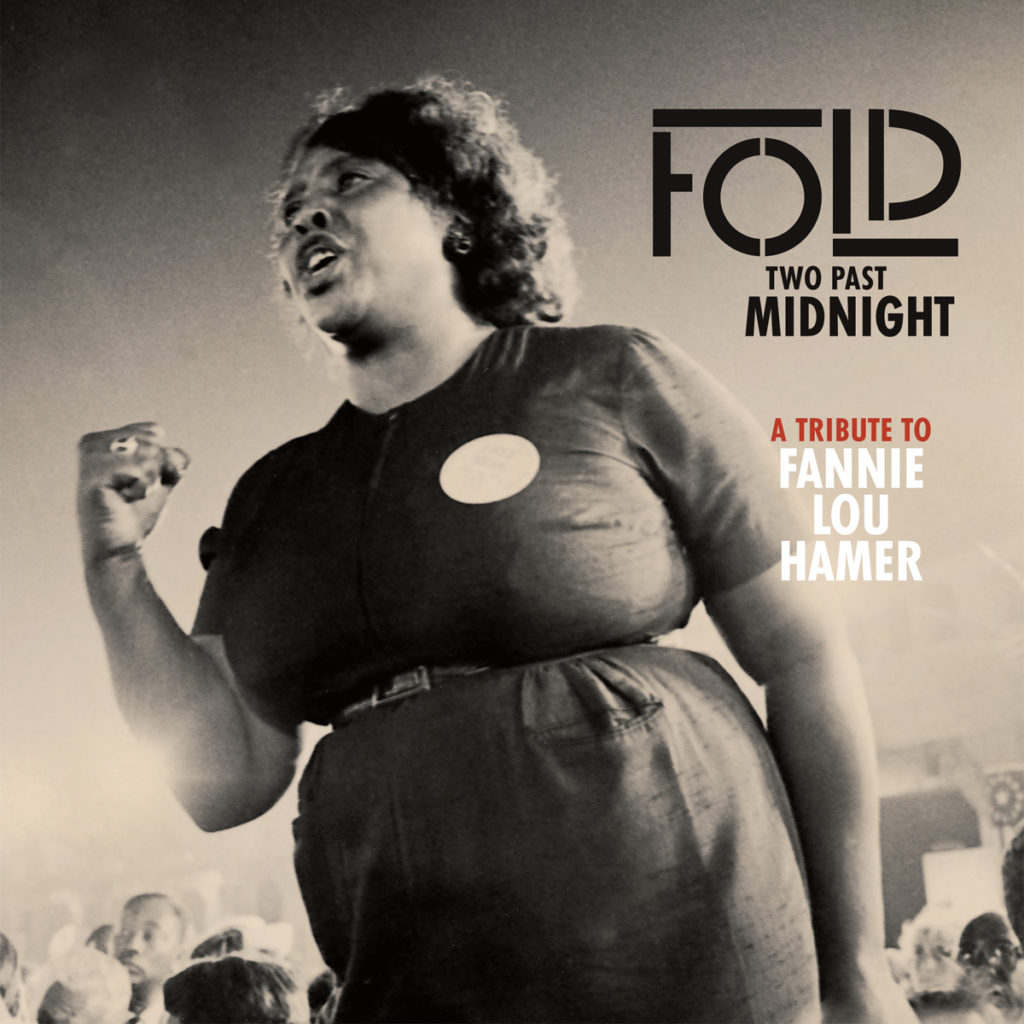
On the 10th anniversary of our debut album, this story reflects on how civil rights activist Fannie Lou Hamer came to occupy the album’s closing track along with one of its key singles
By Seth Mowshowitz · Oct 25, 2025
In the years leading up to our debut album—beginning around 2009—I was combing archives for speech samples and researching people of the proverbial resistance across the history of recorded human voices. At a certain point I realised that my selection was dominated by men. Very few women had entered my awareness and most of them were white. It was a moment of epiphany. I resolved to increase my awareness.
I went straight down a rabbit hole and almost immediately discovered the ‘Pacifica Radio Archives — A Living History presents: The Power of African American Women’, a 9 disc box set collection of speeches lovingly uploaded to archive.org. Some names I was familiar with: Alice Walker, Lorraine Hansberry, Rosa Parks, Angela Davis. My knowledge of each was not deep by any means but I had at least a vague grasp of their impact.
Yet there were so many names I had never even registered before: June Jordan, Florynce Kennedy, Shirley Chisholm, Lena Horne, bell hooks, Carmen McRae, Gwendolyn Brooks and Fannie Lou Hamer, among others. Now, I was born in 1977, grew up in the 80s & 90s and had about the most liberal education you could get in those days. I first learned of the civil rights movement from my excellent 5th grade teacher Ms Baron, who did not shy away from teaching us about lynchings or anything else. She kept shit real. I remember doing a report and presentation on Langston Hughes with a little drawing of him on there along with a few of his poems.
The most important thing in all of this is the fact that by the age of around 32—despite my middle class background, education, political leanings and social consciousness—I had so little awareness of any of these women. Thinking back, most of my generation knew about Martin Luther King Jr and maybe Rosa Parks. I found out about the likes of Malcolm X and Huey Newton from Chuck D’s Public Enemy in the late 80s, not at school. I’d heard of Alice Walker because ofThe Colour Purple and Lorraine Hansberry from reading A Raisin In the Sun in an English lit class, though I knew little about either of them really and even less about Angela Davis, apart from Eddie Murphy referring to her afro.
What about the rest? Shirley Chisholm was the first black woman to be elected to US Congress and I can’t remember her name ever being mentioned. Fannie Lou Hamer was undeniably instrumental in securing voting rights for African Americans by pressuring LBJ to pass The Voting Rights Act in 65. June Jordan and Gwendolyn Brooks: two of the foremost poets of their generations, yet I knew nothing of them either.
What does that say about popular culture, mainstream media and the US education system? Many, many historical figures who have earned their place in the civil rights narrative and arts canons are simply left out of them, and most of those are women. I believe this is largely deliberate. Their stories empower the wrong kinds of people if you’re pushing through a fascist, patriarchal autocracy. Even MLK’s story is told in the most sanitised way possible, usually leaving out his vehement opposition to Viet-Nam and the Military-Industrial Complex, which are often cited as chief reasons for his assassination.
Out of this unexpected deluge of civil rights titans and phenomenal artists emerged a voice with more oomph, more gravitas, more fire than most: the great Fannie Lou Hamer. She spoke differently to anyone else I’d ever heard. As I learned about her life my heart broke for what she’d been through. Having come from such humble beginnings, poverty and total lack of privilege, to then being horribly abused and despite all of that rising and rising to empower those who followed her and make enormous waves in her own nation—eventually running for both the US House and Senate—was a truly remarkable achievement. She died in 1977, the year I was born, at the age of 59. On January 4, 2025 she was finally awarded the Presidential Medal of Freedom by Joe Biden though you probably didn’t hear about it.
One of her speeches in particular hit me like a ton of bricks. Speaking at the Vietnam Moratorium rally at U.C. Berkeley on October 15, 1969, Fannie Lou Hamer killed it like no other. That speech sends shivers down my spine every time I listen to it—her fire, her utter conviction from a place of deep, deep love moves me every level.
How is it possible that this phenomenal human being has been all but left out of the story by all these institutions and popular culture? With that in mind, I felt I had to amplify her speech any way that I could. I developed a demo and edited excerpts of the speech into a distilled narrative, essentially calling out the ongoing brutality of systemic racism and demanding equal rights—real change. I also edited in parts of an earlier interview over the breakdown section to provide some tonal contrast while still elaborating on the same themes.
I took the demo to the rest of the group and they worked out their own parts with their singular talents, developing the sound into something more cohesive and explosive yet still funky at its core. With the help of our brilliant co-producer and engineer Ed Heaton we ultimately recorded our single Two Past Midnight, which also became the closing track on our debut album. In fact we’ve closed virtually every gig we’ve played since then with it.
Once we decided to release Two Past Midnight as a single, we felt that it needed a B Side. During this period, I was in my deepest funk phase—I will always love funk—with emphasis on The Meters (my favourite band of all time), War, Sly & the Family Stone and James Brown. I’d been on the Craig Charles Funk & Soul Show (BBC 6 Music) for a call-in feature called ‘spinage a trois,’ where you pick 3 records that Craig then plays on the air and you explain why you picked them. I chose cuts from The Meters, War and Charles Wright & the Watts 103rd Street Rhythm Band. At the end of 2015 I even published an article in tribute to Cynthia Robinson (Sly’s trumpet player) and Allen Toussaint (architect of the New Orleans sound of the 70s, producer of The Meters)—who both died that year—and in praise of Kendrick Lamar, who did his best to make up for their loss.
I’d been playing Meters licks and riffs on guitar since the 90s and was desperate to form a Meters cover band or at least cover a Meters track with Fold on stage, which I did eventually manage to convince the group to do. None of them were hugely into funk. We played That Good Old Funky Music just once at a gig in Leicester with me on lead guitar and vocals. I know I loved it, not so sure about the rest of the group… or the audience.
So at this time funk was very much in the air and in my bones and sinews. We needed a B Side but unfortunately we’d already used all of our studio budget, so I was forced to improvise. I had this idea to do a remix of Two Past Midnight as the B Side, originally with the intention of asking another artist but there wasn’t enough time so, as someone who had already produced many remixes, I decided to do it myself.
Since the Fannie Lou Hamer speech was actually from 1969—amidst the dawn of funk—I then had the idea to attempt more of a ‘period piece’—to try making it sound as though Hamer had rapped over a funk groove a la Gil Scott-Heron. The character shifted. This called for something a little more cheeky and sassy but still backed by that same fire. Fannie Lou had no trouble providing all of this. “Its a lot of people that said well, forget about politics. But baby: what we eat is politics…” and it goes from there.
I didn’t even need to ask the lads, I totally had this. I pulled out all the stops; wrote and recorded all of the parts in my little attic studio by myself over a couple of days, channeling The Meters on guitar and Sly on rhodes, horns and drums. I mixed the record trying out as many 70s tricks as I could muster, using Meters tracks as reference, including Just Kissed My Baby. The marriage of elements was so fortuitous—it just clicked almost instantly. I’d describe it as equal parts cheeky and sharp. My friend Erik Aldrey did a quick master and BOOM — Don’t Kid Yourself Baby was born.
The single was well received but surprisingly the B Side was the forerunner. Craig Charles played Don’t Kid Yourself Baby on his BBC 6 Music show 3 times and declared it one of his Funk and Soul Stompers of 2015. That was the seal of approval for me, a kiss from Daddy as it were. BBC Radio Leeds’ Alan Raw interviewed us and was particularly impressed with the kick drum, as I recall. I didn’t tell him that I’d programmed it. More recently it became the theme tune to a podcast called The Persistence.
The thing I was most proud of though was getting Fannie Lou Hamer on national radio and TV in my time. Both the A & B Sides had numerous plays on multiple shows across the BBC, Italy’s Radio 2, RTE 2fm in Ireland, Amazing Radio and more. Two Past Midnight was even used on an episode of a popular UK TV show. That’s the kind of exposure I was hoping for. Even though most people don’t necessarily take the time to find out who it is, the voice and the words will stick with them.
To close, Fannie Lou Hamer is reappearing on our meta-celebration EP 10 Past Midnight, due for release on November 2, 2025 — 10 years to the day after our debut album came out. Long may she be both remembered and celebrated.
